Seeing God
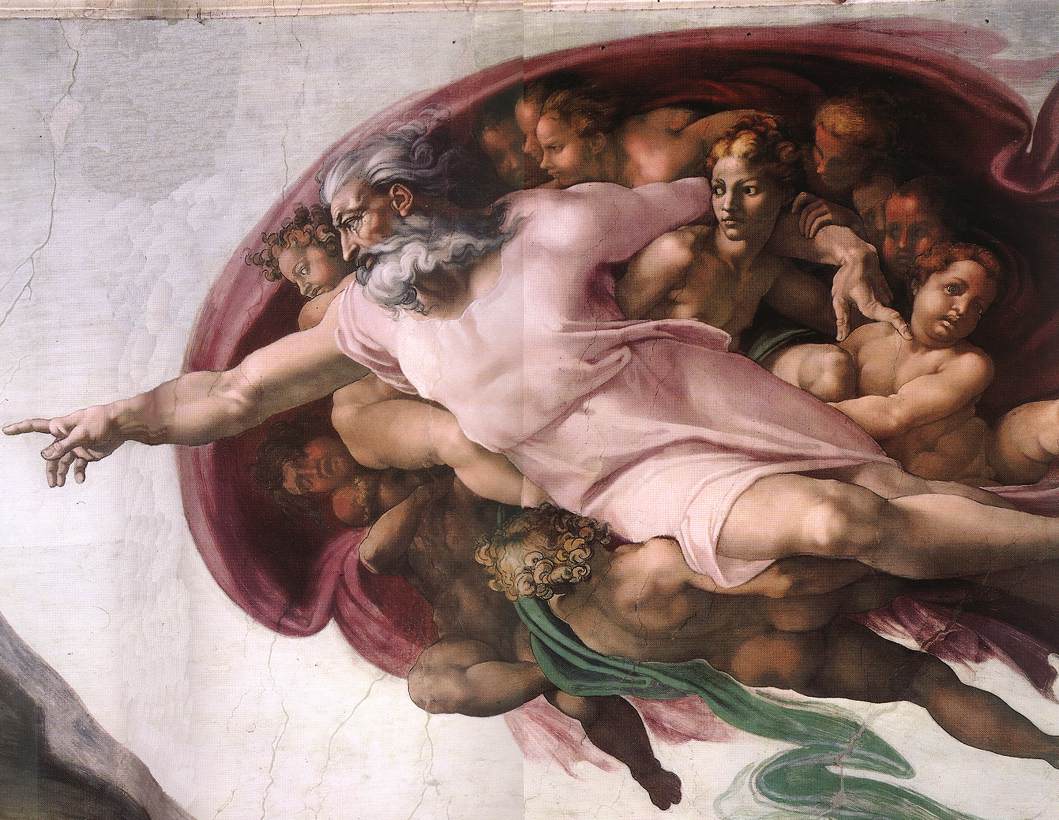
One of the things I like about Hinduism, as well as other religions in this same vein, is that it gives the devotee the freedom to imagine and relate to God in whichever form makes the most intellectual and emotional sense.
The Godhead, or more precisely Nirguna Brahman, is formless, unmanifested potentiality, but there is also Saguna Brahman, which is form, attributes, personality, along with the human-generated mythos.
It’s been said that the Industrial Revolution led people to think about God as a clockmaker, with the Universe operating with mechanical precision.
Well, I’ve definitely started thinking of God in more mathematical and computational terms. Instead of viewing God as King who sits on the throne, reigning and passing judgment, and being disappointed in your life choices, I’m much more drawn to the idea of God as the ground of being and consciousness that operates like a computational model or a feedback mechanism from control theory.
The idea of Karma is that it’s not some big person that judges you and casts you down to hell; rather, it is the interplay of your actions and how cause and effects send ripples out into space and time and come back in ways you didn’t expect.
That, to me, seems way more like an algorithm than a reified superhuman being that Feuerbach was quick to criticize. Of course, there are advantages to viewing God as a person, and if that works for you, great. I just realize that how I see God has changed, and there really isn’t a right or wrong way.
I love the idea behind spiral dynamics: that the evolution of our own consciousness is an ongoing process that aims ever upwards and outwards, encompassing prior stages. I think it’s a great illustration of how your understanding of yourself and of God can, and should, change.
Paul’s famous words keep echoing in my ears:
“For we know in part and we prophesy in part, but when the perfect comes, the partial will pass away. When I was a child, I spoke like a child, I thought like a child, I reasoned like a child. When I became a man, I gave up childish ways. For now we see in a mirror dimly, but then face to face. Now I know in part; then I shall know fully, even as I have been fully known”
And of course I can’t forget about this gem:
“And we all, with unveiled face, beholding the glory of the Lord, are being transformed into the same image from one degree of glory to another. For this comes from the Lord who is the Spirit.”
There is a fractal process of seeing and being seen that leads to an unfolding of the beatific vision. Spiritual maturity involves realizing that your way of seeing isn’t the only one, but it is YOURS, and resting in the righteousness of your path, your way of seeing, and your knowing God.
I could go on more about this, but that’s the nugget I wanted to share. It doesn’t matter how you imagine God; God can appear as nothing at all or simply as Nature itself. Many faces are worn, and wherever you gaze upon the infinite, gaze long enough, and it will look back into you!